The Funnel Gambling Experience
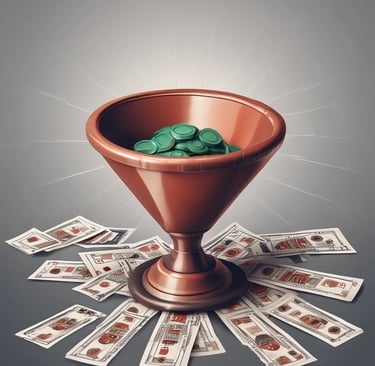
In this article, I describe what I call the funnel gambling experience. A funnel takes in much but releases very little. In the same way, in gambling, a lot of money is invested but only a few—often countable—ever win.
GAMBLING
Fr. Fred Wekesa
1/4/20264 min read

The Funnel Gambling Experience
In this article, I describe what I call the funnel gambling experience. A funnel takes in much but releases very little. In the same way, in gambling, a lot of money is invested but only a few—often countable—ever win.
At the age of 15 years old, my mother sent me to the market to buy some Maize. When I reached Mayanja Market in Bungoma County, I found a group of people playing cards. Curiously, I stopped to watch. As I observed, I noticed that one of the bystanders won KSh. 300 simply by predicting the correct card. I felt encouraged by what I saw, I decided to try my luck.
After a tough reshuffle of the cards, I was ready to place a bet, but unfortunately, I did not have any cash. The gamblers then asked me to stake anything I had, so I decided to gamble by giving my Watch. While I was removing it to place the bet, they secretly changed the winning card. When I finally placed my watch, my prediction was wrong. Just like that—my watch was gone. I walked away immediately and went straight to buy the maize that my mother had sent me.
On my way home, I was haunted by one question: “How foolish was I to want to win money in exchange for my watch?”
I wondered what would have happened if I had gambled the money meant to buy Maize. How lucky I was, because if I dared to use it to Gamble, she would have punished me severely. On ther other hand, the man who was leading the gambling at the Market happens to come from the nearby Village, so One day, I met him wearing my Watch. This was not chance; it was strategy.
Albert Einstein once said, “You cannot beat a roulette table unless you steal money from it.” From Einstein’s time to today, gambling has existed, but winning remains a matter of pure luck, not a skill. No amount of strategy can change the odds that are already fixed against the gambler.
The Twisted Reality of Gambling
Gambling environments are designed to create the illusion that winning is just within a reach of everyone. In casinos, sports betting and other gambling platforms—especially radio promotions—presenters speak as if listeners are only inches away from a big win, but it is only to entice you to participate in gambling.
For example, I once heard a Kenyan radio presenter describing three boxes in the studio—one containing a large sum of money, while the other two were empty. Listeners, of course, could not see the boxes, but they were required to guess by sending a message. However, there was another listener who sent three messages to predict but he didn't win anything. In such a scenario, who is more likely to win? The presenter who sees the box with the money, or the listeners who cannot see anything but they are persuaded to believe the presenter’s words? This reinforces Einstein’s idea: You cannot win money from the roulette unless you steal money from it.
Hidden Losses in Gambling
Another reason gamblers rarely win but the company wins always is transaction fees. Whether you win or lose, you must pay to participate—sending messages, placing bets, or withdrawing winnings, therefore, it is the gambling company that wins. Even when someone wins, a portion of the money is deducted through transaction charges. Ultimately, the gambling company profits regardless of the outcome.
In fact, the few winners are paid using the money contributed by the many who had lost. The system is structured to benefit the operator, not the gambler.
Traditional vs. Modern Gambling
I personally prefer traditional betting. For example, when two people would bet on a football match outcome, the winner would receive what the other had committed to give. If there is a draw, both parties keep their stakes—no one loses unfairly.
Modern gambling is far away different. There is always a middleman in the name of the company as the Operator. This company earns money whether gamblers win or lose, mainly through fees Charges and other commissions. In this system, the gambler carries all mental health risks such as over borrowing, insomnia and stress, while the company gains financially.
Conclusion
Gambling responsibly is essential because many people invest, but only a handful could win. Gambling is not a skill-based activity; it depends entirely on luck and not the skills of the gambler The funnel gambling experience reminds us that much goes in terms of gambling, but very little comes out in terms of those who win.
Unless one is extremely lucky, gambling will always favor the system and not the player.
Fr. Fred Wekesa


Fred Wekesa is an Augustinian catholic priest from St. Rita Vicariate in kenya. He is an Author of several books such as "Augustinian Friendship" and "L'Amitié Augustinienne". He is a counselling Psychologist with a Master's degree in counselling psychology from Mount Kenya Unversity. Currently, He is a Doctoral student in COUNSELLING PSYCHOLOGY at Mount Kenya University. He is a Rector of Saint Augustine Basilica, Annaba, Algeria.