3rd Sunday of lent year A
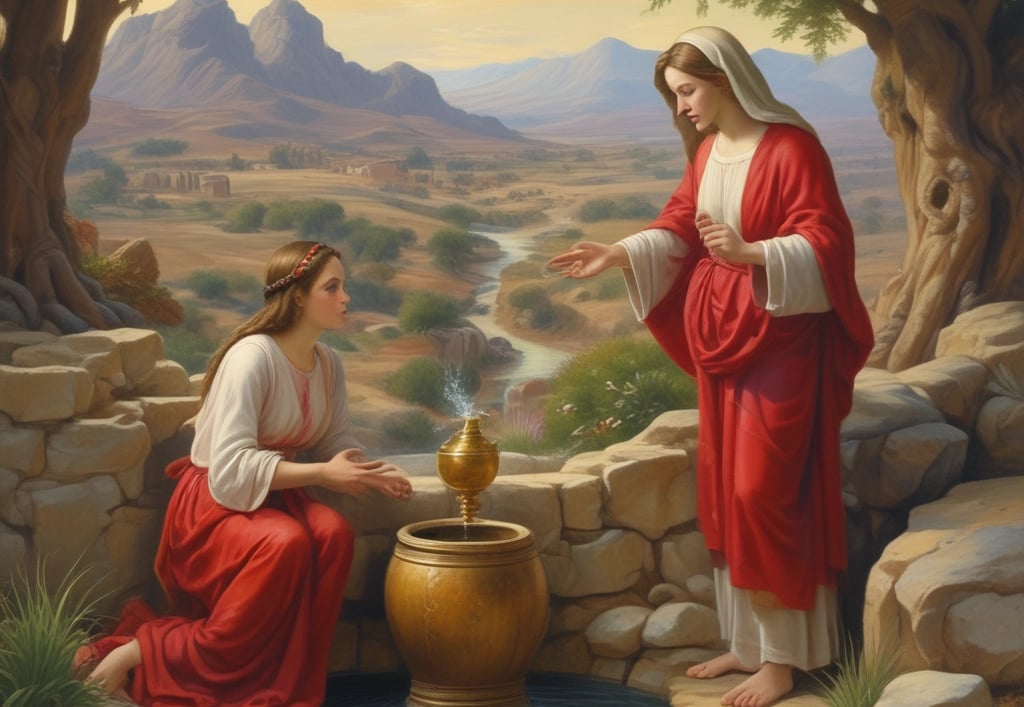
On this 3rd Sunday of lent year A, We encounter the Samaritan woman with Jesus at the Well.
Fr. Fred Wekesa, OSA
3/4/20264 min read
3rd Sunday of Lent year A
“Give me water to drink”
Dear brothers and sisters, this is a Homily for 3rd Sunday of Lent year A. On this Sunday, we reflect on the personal encounter of the Samaritan woman with Jesus at the well of Jacob. We shall look at what the well represents, the kind of living water that Jesus gives and finally the lessons learned from this gospel passage.
On this 3rd Sunday of lent year, A, in the first reading, we find the people of Israel who were thirsty, turned to Moses for water to drink, Moses turned to God for a solution and eventually they had water to drink. Indeed, water is one of the most important components that we should have in our life as human beings.
In the gospel passage, we find Jesus who leaves Jerusalem to go back to Galilee, but on the way, he stops at Samaria specifically at the well of Jacob. That is where he meets a Samaritan woman. But one may ask, what does the well represent in the biblical terms? The well represents the following:
1. A place to fetch water. For example, we are told that women used to fetch water from the well since the time of Jacob that is why it was named the well of Jacob.
2. A strategic place to find a wife. For example, Abraham who wished to find a wife for his son Isaac, send his servant at the well to find a wife for Isaac, of course, he found Rebecca (Genesis 24:10-67). Again, Jacob found his wife Rachel at the well (Genesis 29:1-17), Moses also found his wife Zipporah at the well (Exodus 2:15-21 ) and finally Jesus meets a Samaritan woman with different reasons of giving her some living water. Finally,
3. Living water for our spiritual thirst.
When Jesus arrived at the well, the text tells us that he was tired and thirsty, was he really? I don’t think so because 1. When the disciples came back and gave him some food, he refused and said “My food is to do the will of my father who sent me”. Hence, he was not hungry and thirsty. The second reason would be that Jesus being thirsty and tired highlights the condition of the Samaritan woman who was thirsty for living water because she was tired of coming to the well every now and then. In fact, an empty jar that she had for fetching water could be taken to symbolize her emptiness in life. In a nutshell, Jesus wants to refill her emptiness with some living water, eternal life. During this Lenten period, May Christ refill our emptiness in our hearts , May Christ refill our emptiness in our families, May Christ refill our emptiness in our emptiness in our societies and May Christ refill our emptiness in our world today.
On the other hand, the dialogue between Jesus and the Samaritan woman reveals the following points;
1. Faith is a journey. The Samaritan woman progressively recognized Jesus as a Jew, who is greater than Jacob, as a prophet, as a messiah and above all as the saviour of the world. Indeed, she acknowledged Jesus as a gift from the father not at once but step by step. How and when does our faith progressively lead us to recognize and acknowledge Jesus as the saviour of the world?
2. The symbolic meaning of Water. In this context, there were two levels of understanding the reality of water, that is the Samaritan understands the ordinary way water is used whereas Jesus explains the spiritual meaning of water to the Samaritan woman. In fact, Living water as expounded by Jesus meant the spirit. For example, Isaiah 44:3-4 “I will pour water on the dry land…I will pour out my spirit upon your offerings”. In the same perspective, for Prophet Ezekiel, he combines the understanding of water and spirit when proclaiming the new covenant. Finally,
3. The removal of barriers such as the difference between a Samaritan and a Jew, the religious and even nationality differences respectively.
What are the messages for us Christians today from this 3rd Sunday readings?
1. Personal encounter with Jesus in our Christian life. For example, a Samaritan woman had a personal experience with Jesus, the saviour. Let us not only hear Jesus being preached or talked about but have a personal experience with him.
2. The usage of water in this passage symbolizes Baptism. During Easter vigil mass, we shall use water to baptise some catechumens. Moreover, some of us were baptised with water. Do we know and recognize that we received a living spring of water in us? In fact according to the gospel of Saint John, eternal life starts when one is baptized. Do we recognize and live according to the baptismal promises?
3. Let us thirst and hunger to do good in our Christian life. Whenever we experience some difficulties, let us turn to God like the people of Israel who turned to Moses and eventually Moses turned to God for the solution.
4. Faith is a long journey process that is characterized by doubts sometimes. Finally,
5. We need social, economic, and political redemption in our society today.
To conclude, on this 3rd Sunday of lent year A, we are called to dialogue with Jesus who is the source of living water in our Christian life. AMEN
HAVE A BLESSED SUNDAY!!!!!!